Renting out an inherited property or a second home is a fantastic way to generate passive income in India. However, many new landlords mistakenly believe that rental income is entirely tax-free or that it can be easily hidden from the Income Tax Department by accepting rent in cash.
Under the Income Tax Act, 1961, rental income is strictly taxable under the head "Income from House Property." Ignoring this can lead to severe penalties, especially now that the IT department uses advanced AI to track high-value transactions and PAN linkages. Fortunately, the law also provides highly generous deductions that can significantly reduce your tax burden. This comprehensive guide breaks down exactly how your rental income is calculated, what deductions you can claim under Section 24, and the common pitfalls landlords must avoid to stay legally compliant.
1. Understanding "Income from House Property"
When you earn rent, it is not taxed directly on the gross amount you receive in your bank account. Instead, the Income Tax Department requires you to calculate the "Net Annual Value" (NAV) of your property. Your final tax liability is determined based on this specific NAV calculation.
The basic formula for calculating NAV is:
Gross Annual Value (Total Rent Received) - Municipal Taxes Paid = Net Annual Value (NAV)
It is critically important to note that you can only deduct municipal property taxes if they were actually paid by you (the owner) during the financial year. If the tenant paid the property tax (which is rare but happens in commercial leases), or if you delayed the payment to the next year, you cannot claim the deduction for the current year. Ensure you keep the municipal tax receipts safe.
2. The Magic of Section 24(a): Standard Deduction
Once you have calculated your Net Annual Value (NAV), you don't pay tax on that full amount. To account for the inevitable costs of maintaining a house—such as painting, plumbing repairs, society maintenance, and property insurance—the government offers a massive flat deduction to all landlords.
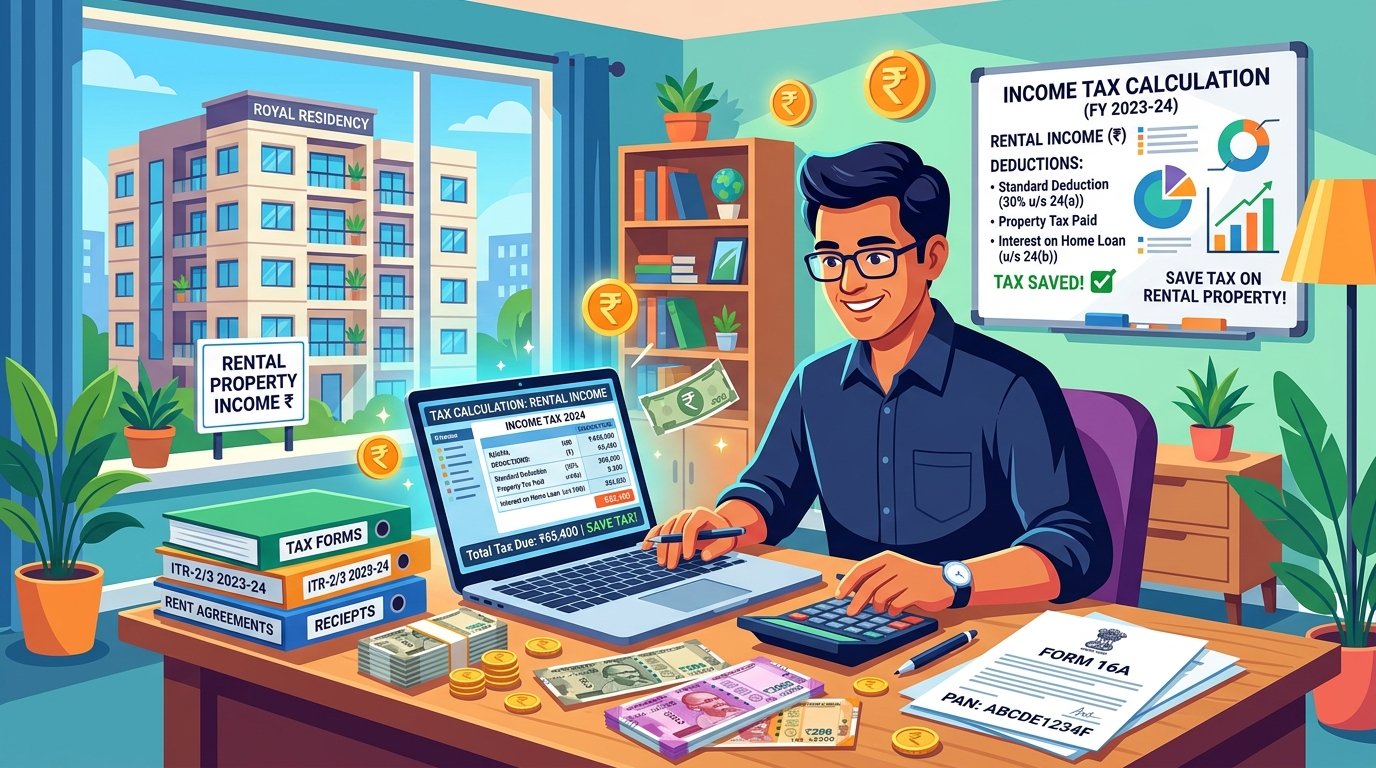
Under Section 24(a) of the Income Tax Act, you are legally entitled to a Standard Deduction of exactly 30% of the NAV.
- This 30% deduction is unconditional and universally applicable to all let-out properties.
- You do not need to produce any bills, invoices, or receipts for repairs to claim this.
- Even if you spent absolutely zero rupees on maintaining the house that year, you still get to deduct 30% from your rental income before it is taxed. It is a massive statutory benefit.
3. Deduction for Home Loan Interest: Section 24(b)
If you purchased the rented property using a home loan, you get an additional, incredibly powerful tax benefit that can sometimes wipe out your rental tax liability entirely.
Under Section 24(b), you can deduct the entire interest amount paid on your home loan during the financial year from your rental income. Unlike a self-occupied property (where the interest deduction is strictly capped at ₹2,00,000), there is no upper limit on the interest deduction for a let-out (rented) property under the Old Tax Regime.
This means if you are earning ₹4,00,000 in rent, but paying ₹4,50,000 in home loan interest, your income from house property actually becomes a loss of ₹50,000. You can legally set off this loss against your salary or business income (up to a limit of ₹2,00,000 per year), further reducing your overall tax burden.
4. TDS on Rent: What Landlords Must Know
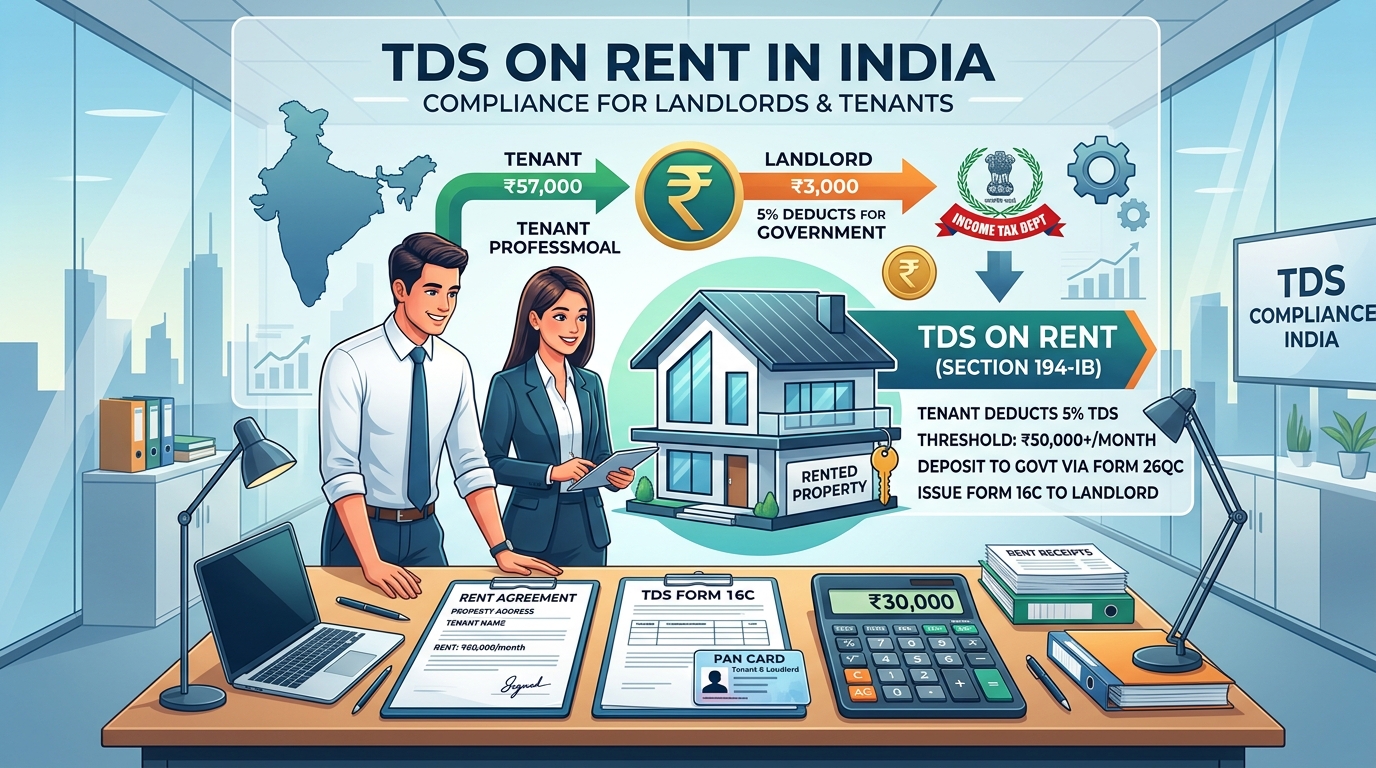
If your tenant is an individual or a standard salaried employee paying rent up to ₹50,000 per month, there is no Tax Deducted at Source (TDS) applicable. You receive the full rent amount in your bank account without any deductions.
However, if the tenant is paying rent exceeding ₹50,000 per month, they are legally required under Section 194-IB to deduct 5% TDS from the rent and deposit it with the government against your PAN. This is not money lost; it is tax paid in advance. When you file your ITR, this 5% TDS will be adjusted against your final tax liability as a refund or credit. Ensure your tenant gives you a Form 16C as proof of this deduction so you can claim it properly.
5. Can I Hide Rental Income by Taking Cash?
Attempting to evade taxes by forcing tenants to pay rent in cash is highly illegal and increasingly impossible to hide in modern India. The IT department now mandates tenants to declare the landlord\'s PAN if their annual rent exceeds ₹1,00,000 in order to claim their own HRA (House Rent Allowance) exemptions.
The moment your tenant submits your PAN to their employer, the tax department knows exactly how much rent you are receiving. If you fail to declare this matching income in your ITR, you will receive an automatic scrutiny notice, leading to massive penalties (up to 200% of the tax evaded) and compound interest charges. Always declare your rental income honestly and use the legal 30% deduction to minimize the tax legally.
6. Joint Ownership Benefits
If you own the property jointly with your spouse, the rental income is split between both co-owners according to their share of ownership. This allows both of you to utilize your basic exemption limits and lower tax slabs, significantly reducing the total household tax liability compared to a single owner bearing the entire rental income.
7. Understanding Co-ownership and Tax Slabs
If you own the property jointly with a spouse or a family member, the rental income is proportionately split between both co-owners according to their respective shares of ownership (e.g., 50-50 or 60-40). This is an incredibly powerful tax planning tool because it allows both individuals to utilize their basic exemption limits and lower tax slabs independently. For example, instead of one person adding ₹10 Lakhs of rental income to their 30% tax bracket, two people can add ₹5 Lakhs each, potentially bringing the income into a 5% or 10% tax bracket, or even keeping it tax-free if they have no other income. To claim this, the property must be legally registered in both names, and both must fund the purchase.
8. What About Vacant Properties?
Many landlords keep their second homes vacant because they do not want the hassle of finding a tenant. However, under the Income Tax Act, if you own more than two residential properties, the third property (and any others) will be considered "Deemed to be Let-Out" even if it is locked and vacant. You will have to calculate a "notional rent" based on what the property could reasonably fetch in the open market, and pay tax on that imaginary income. Therefore, it is always financially wiser to rent out your vacant properties to actual tenants, allowing you to earn real cash to offset the taxes you are forced to pay anyway.
9. Commercial vs. Residential Taxation
It is important to note that the rules for residential and commercial rental income are largely similar under the head "Income from House Property." You still receive the 30% standard deduction for commercial properties. However, if you are actively providing complex services along with the commercial space (like IT infrastructure, security staff, or specialized machinery), the IT department might classify your income under "Profits and Gains from Business or Profession." If classified as business income, you lose the flat 30% deduction but can instead deduct actual expenses (like staff salaries and heavy depreciation on assets) incurred to run the commercial leasing business.
Conclusion
Rental income is a great asset, and the Indian tax system provides generous, legal ways to minimize the tax burden through the 30% standard deduction and unlimited home loan interest deductions. By understanding the NAV calculation, keeping track of municipal taxes, and ensuring your tenant complies with TDS rules if applicable, you can build a profitable, legally secure real estate portfolio.